Postum, Pero and Chicory: A Short History of Coffee Substitutes
For generations, many vegetarian and health-minded households started the day with a warm, dark, roasty mug of something that looked like coffee but wasn’t. If you grew up around Seventh-day Adventist kitchens, church potlucks or health food stores, you probably remember the jars: Postum, Pero, Roma, Cafix. Some tasted surprisingly close to the real thing. Others were their own cozy, malty creatures, and people loved them anyway.
Here’s a short look at where these caffeine-free drinks came from, which ones you can still buy, and how to make a cup you’ll actually look forward to.
Why people looked for coffee substitutes
People have stretched or replaced coffee for at least two centuries, for two main reasons: scarcity and health. When coffee was expensive or impossible to get, roasted roots and grains filled the gap. And as 19th-century health reformers began warning about stimulants, many families, Adventists among them, chose to give up caffeine altogether. They still wanted a hot drink to wrap their hands around in the morning, and roasted grains turned out to be the answer.
Chicory: the original stand-in
Chicory root, roasted and ground, is the granddaddy of coffee substitutes. It has a deep, slightly bitter, almost chocolatey flavor that blends naturally with coffee. Mixing chicory into coffee probably began in Holland and reached France around 1801, and the habit traveled with French settlers to Louisiana. During the Civil War, when Union naval blockades cut off the port of New Orleans, residents stretched their dwindling coffee with chicory, along with acorns and beets. The chicory stuck: coffee-and-chicory with hot milk is still a New Orleans classic today.
Postum: a Battle Creek original
The most famous American coffee substitute was born in Battle Creek, Michigan, the same town that was home to the Adventist-run Battle Creek Sanitarium and the birthplace of the breakfast cereal industry. C.W. Post made his first batch of Postum in 1895 in a small barn, from roasted wheat bran and molasses. According to Spectrum magazine, he had reportedly learned about healthy eating and the downsides of caffeine from a Seventh-day Adventist boarding-house owner in Battle Creek.
Post was a gifted advertiser. His ads ran under the slogan “There’s a Reason,” and a cartoon ghost called Mr. Coffee-Nerves showed up to torment jittery coffee drinkers until they switched to Postum. In 1911 the company introduced Instant Postum, which became the version most people remember. Sales soared during World War II, when coffee was rationed and families went looking for something else to put in their cups.
Postum became a fixture in Adventist homes, and it was just as popular with Latter-day Saint families, who also abstain from coffee. So when Kraft quietly discontinued Postum in 2007, loyal drinkers were heartbroken. Some hoarded jars, and others paid sky-high prices online. Fans campaigned for years to bring it back, and in 2012 a small company, Eliza’s Quest Foods, bought the trademark and the original recipe from Kraft. Postum was back on store shelves within a few years and is still sold today.
Grain coffees from Europe
Across the Atlantic, Europe has its own long tradition of roasted grain “coffees,” especially in Germany. The best known is Caro, a blend of roasted barley, malted barley, chicory and rye introduced in West Germany in 1954 and now made by Nestlé. In the United States, that same drink is sold as Pero.
The jars you can still find today
Good news: most of the classics are still around, in health food stores, many grocery stores and online.
- Postum: Roasted wheat and molasses, with no barley or chicory, so it has a gentle, slightly sweet, toasty flavor. Stir a spoonful into hot water or milk.
- Pero: Barley, malted barley, chicory and rye. Smooth, mild and malty, and it dissolves instantly.
- Kaffree Roma: Roasted barley, malted barley, chicory and rye, with a full-bodied, roasty taste. A spoonful makes a cup, so one jar goes a long way.
- Cafix: Roasted barley, rye, chicory and sugar beets, made in Poland. Slightly sweeter and lighter than the others.
- Teeccino: A newer “herbal coffee” created by tea designer Caroline MacDougall and launched in 1995. It’s made from roasted herbs, fruits and nuts such as chicory, carob, dandelion and ramón seeds, and it’s ground so you can brew it in a coffeemaker or French press, just like coffee. Many people find it the closest to the real thing.
You’ll also find roasted dandelion root blends, mushroom “coffees,” and plain roasted chicory sold on its own for mixing your own blend.
How to make a cozy cup
Instant grain beverages are mellow on their own, and a few small touches make them feel special:
- Use milk. Make it half hot water and half hot milk (dairy or plant-based) for a creamy, café-au-lait-style drink. Oat milk is especially good.
- Sweeten lightly. A little honey, maple syrup or brown sugar brings out the roasted, caramel notes.
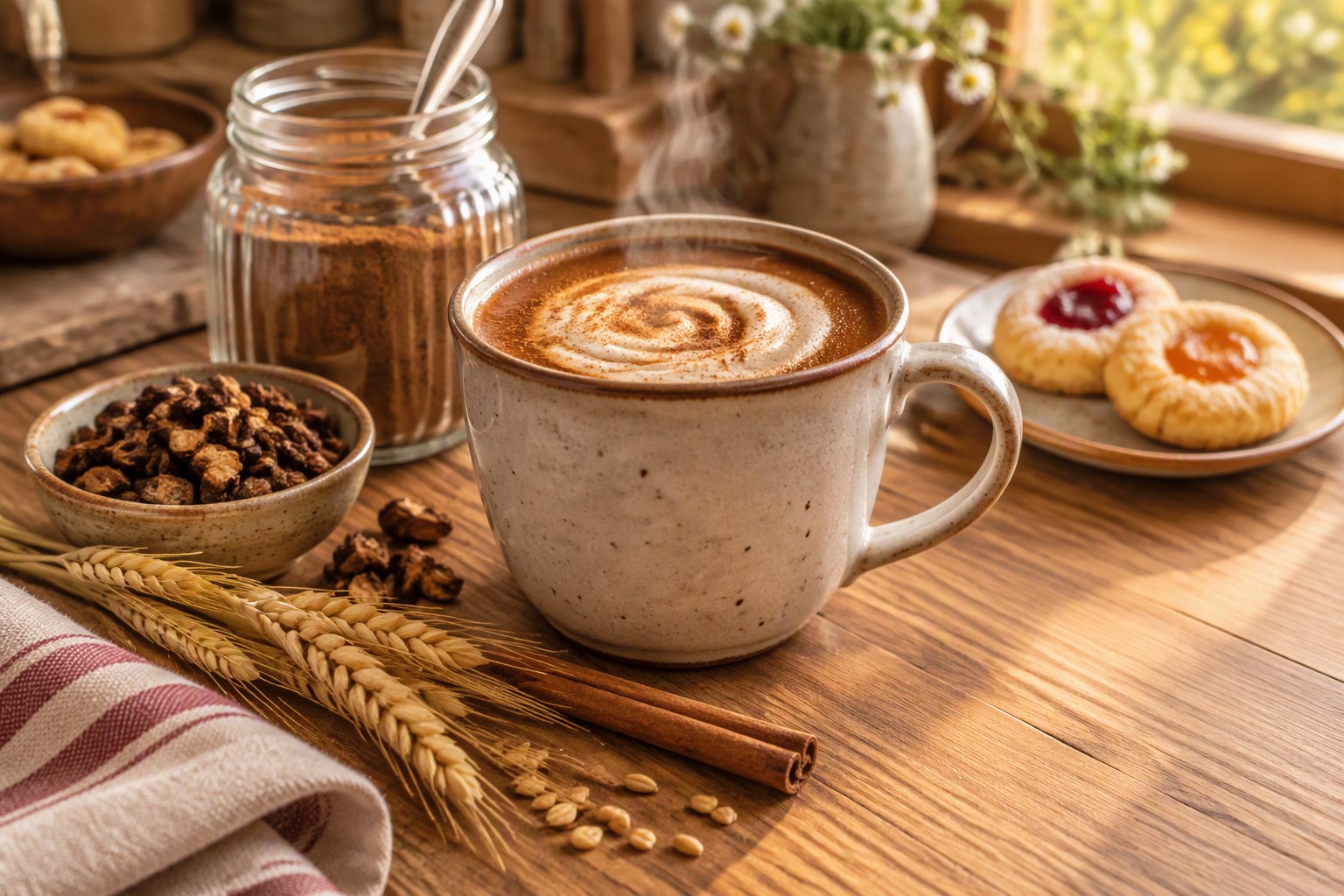
- Add spice. A pinch of cinnamon, a drop of vanilla or a dusting of cocoa turns an ordinary cup into a treat.
- Make it stronger. If it tastes thin, add a little more powder. Brewed herbal coffees like Teeccino can be steeped a few minutes longer for a bolder cup.
- Try it iced. Dissolve the powder in a splash of hot water, then pour it over ice with cold milk.
A note on gluten: Because most of these drinks are made from barley, rye or wheat, they aren’t gluten-free. If you avoid gluten, read labels carefully and look for chicory-, dandelion- or carob-based blends marked gluten-free.
Pour a cup and stay a while
Whether you’re cutting back on caffeine, want something warm in the evening that won’t keep you up, or just feel nostalgic for the jar that sat by your grandmother’s stove, a roasted grain drink is worth rediscovering. It goes perfectly with a slice of Spinach and Mushroom Quiche, a square of Cinnamon French Toast Casserole, or a plate of Jam Thumbprint Cookies.
Love the history of vegetarian foods? Read our short history of Loma Linda, Worthington and Cedar Lake, the brands behind Big Franks, Choplets and FriChik.